
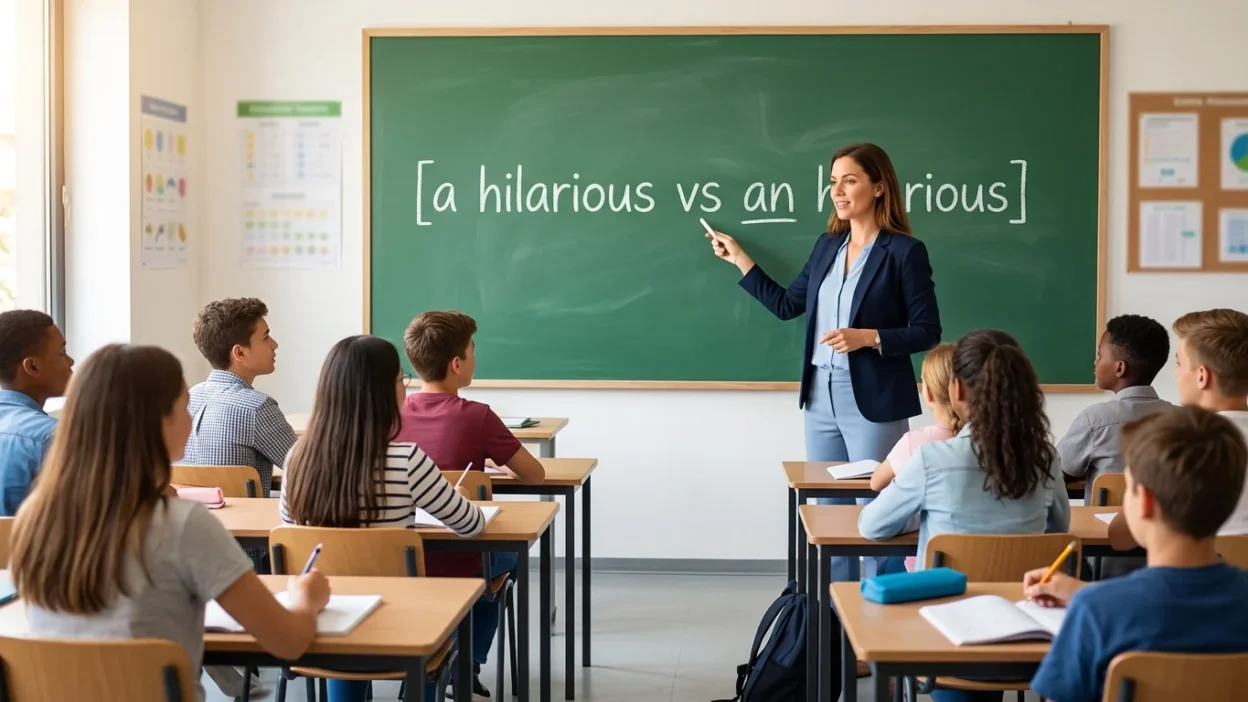
Choosing between a hilarious and an hilarious can be confusing because the word hilarious begins with the letter h and English articles are sometimes difficult to choose based on spelling alone. However, the important factor is not the letter itself but the sound that follows the article.
In standard modern English, a hilarious is the correct form because the h in hilarious is pronounced. We therefore use a before it, just as we say a happy person or a helpful teacher. An hilarious is generally considered nonstandard in contemporary English, although it can occasionally be found in older writing or varieties where the initial h is not pronounced.
Quick Answer
The correct form is a hilarious, not an hilarious, in standard modern English.
- ✅ a hilarious joke
- ✅ a hilarious story
- ✅ a hilarious movie
- ❌ an hilarious joke
- ❌ an hilarious story
The reason is simple: hilarious begins with a pronounced h sound, which is a consonant sound.
Why People Confuse It
People often confuse a hilarious and an hilarious because they may think the choice between a and an depends on the first letter.
It actually depends on the sound.
Compare:
- a hilarious → starts with /h/ → consonant sound
- an amazing → starts with /ə/ → vowel sound
- a useful → starts with /j/ → consonant sound
- an honest → starts with a vowel sound because the h is silent
So the correct question is not:
“Does the word start with a vowel letter?”
Instead, ask:
“Does the word start with a vowel sound?”
A Hilarious
A hilarious is the standard and correct form when hilarious is followed by a singular countable noun.
Examples:
- a hilarious joke
- a hilarious story
- a hilarious movie
- a hilarious person
- a hilarious situation
Example Sentences
- She told a hilarious story about her childhood.
- We watched a hilarious movie last night.
- He made a hilarious joke during the meeting.
- That was a hilarious mistake.
- They shared a hilarious video online.
You can also use a hilarious when describing a person:
She is a hilarious comedian.
Here, a is required because hilarious begins with a consonant sound.
An Hilarious
An hilarious is generally not the standard choice in contemporary English.
❌ She told an hilarious story.
✅ She told a hilarious story.
❌ It was an hilarious movie.
✅ It was a hilarious movie.
The form an hilarious may occasionally appear in older texts or in speech varieties in which the initial h is dropped. However, if you’re writing standard American or British English today, a hilarious is the natural choice.
A Hilarious vs. An Hilarious Comparison Table
| Feature | A hilarious | An hilarious |
|---|---|---|
| Standard modern English | ✅ Yes | ❌ Generally no |
| Initial sound | /h/ | — |
| Article before pronounced “h” | ✅ A | ❌ An |
| Common in formal writing | ✅ Yes | ❌ No |
| Common contemporary usage | ✅ Yes | ⚠️ Rare/nonstandard |
| Example | a hilarious joke | an hilarious joke |
When to Use Each
Use “a hilarious”
Use a hilarious whenever you describe a singular countable noun with hilarious.
Examples:
- a hilarious joke
- a hilarious story
- a hilarious incident
- a hilarious performance
- a hilarious comment
What about “an hilarious”?
In standard modern English, avoid an hilarious.
If you encounter it in older literature or a particular dialect, it may reflect a pronunciation in which the initial h is not pronounced. But this is not the normal form for contemporary standard English.
Examples (10+)
Here are natural examples using a hilarious:
- She told a hilarious story.
- He made a hilarious joke.
- We watched a hilarious movie.
- That was a hilarious mistake.
- They shared a hilarious video.
- She is a hilarious comedian.
- It became a hilarious situation.
- He gave a hilarious performance.
- We had a hilarious conversation.
- That was a hilarious comment.
- They described a hilarious incident.
- He posted a hilarious picture online.
Incorrect in standard modern English:
- ❌ an hilarious story
- ❌ an hilarious joke
- ❌ an hilarious movie
- ❌ an hilarious situation
Common Mistakes
Mistake 1: Choosing “an” because of the spelling
❌ an hilarious joke
✅ a hilarious joke
The word begins with the consonant sound /h/, so a is required.
Mistake 2: Thinking every word beginning with “h” takes “a”
This isn’t always true.
Some words beginning with h have a silent h:
- an honest person
- an hour
- an honor
Compare:
- a hilarious person
- an honest person
The difference is pronunciation.
Mistake 3: Thinking “an hilarious” sounds more formal
It doesn’t. In contemporary standard English, a hilarious is the normal form.
Mistake 4: Looking only at letters
English articles are determined by sound, not simply by the first written letter.
Memory Trick
Use this simple rule:
A = consonant sound
An = vowel sound
Since hilarious starts with an audible h:
hilarious → a hilarious
Compare:
a hilarious story
an amazing story
Remember:
Hear the H → use A.
American vs British English
Both American and British English normally use a hilarious.
Examples:
- American English: a hilarious movie
- British English: a hilarious movie
The difference is not normally regional. It comes from the pronunciation of the word hilarious.
In both varieties, the initial h is normally pronounced, so a is the appropriate indefinite article.
Similar Words
The same a/an principle applies to many other commonly confused expressions:
- a historic event / an historic event
- a hotel / an hotel
- a honest ❌ / an honest ✅
- a hour ❌ / an hour ✅
- a useful idea / an useful ❌
- a university / an university ❌
- an unusual idea / a unusual ❌
The key is always the initial sound.
Final Verdict
A hilarious is the correct choice in standard modern English. Because hilarious begins with a clearly pronounced h sound, it takes the indefinite article a.
An hilarious is generally not used in contemporary standard English, although it may occasionally appear in older writing or dialectal usage where the initial h is not pronounced.
The easiest way to remember the rule is to focus on pronunciation rather than spelling. If you hear the /h/ sound in hilarious, use a.
FAQs
Is it “a hilarious” or “an hilarious”?
The standard form is a hilarious.
She told a hilarious story.
Why is “a hilarious” correct?
Because hilarious begins with a pronounced h sound. A is used before consonant sounds.
Is “an hilarious” grammatically correct?
An hilarious is generally considered nonstandard in contemporary English. A hilarious is the normal standard form.
Why do we say “a hilarious” but “an honest”?
Because the h in hilarious is pronounced, while the h in honest is silent.
- a hilarious → /h/ sound
- an honest → vowel sound
Is it “a hilarious joke”?
Yes.
That was a hilarious joke.
Is it “an hilarious joke”?
Not in standard contemporary English. The preferred form is:
a hilarious joke
Does British English use “an hilarious”?
Standard British English normally uses a hilarious as well. Regional or older pronunciations may differ, but they do not change the standard modern form.
What is the rule for “a” and “an”?
Use a before a consonant sound and an before a vowel sound.
- a hilarious story
- a useful idea
- an honest person
- an unusual event
Conclusion
The difference between a hilarious and an hilarious comes down to pronunciation. Since hilarious begins with a pronounced h sound, a hilarious is the correct form in standard modern English.
Although an hilarious can occasionally be found in older or dialectal usage, it is not the form you should normally use in modern formal, academic, professional, or everyday standard English.
Remember This
✅ A hilarious = Correct
❌ An hilarious = Generally nonstandard
The rule: Choose a or an according to the sound, not simply the first letter.
Hilarious starts with an audible “H” → a hilarious.

Oliver Owen is the dedicated administrator of MeanHives, ensuring smooth daily operations, maintaining content quality, supporting users, organizing educational resources, and helping learners confidently improve their English vocabulary and word-matching skills.