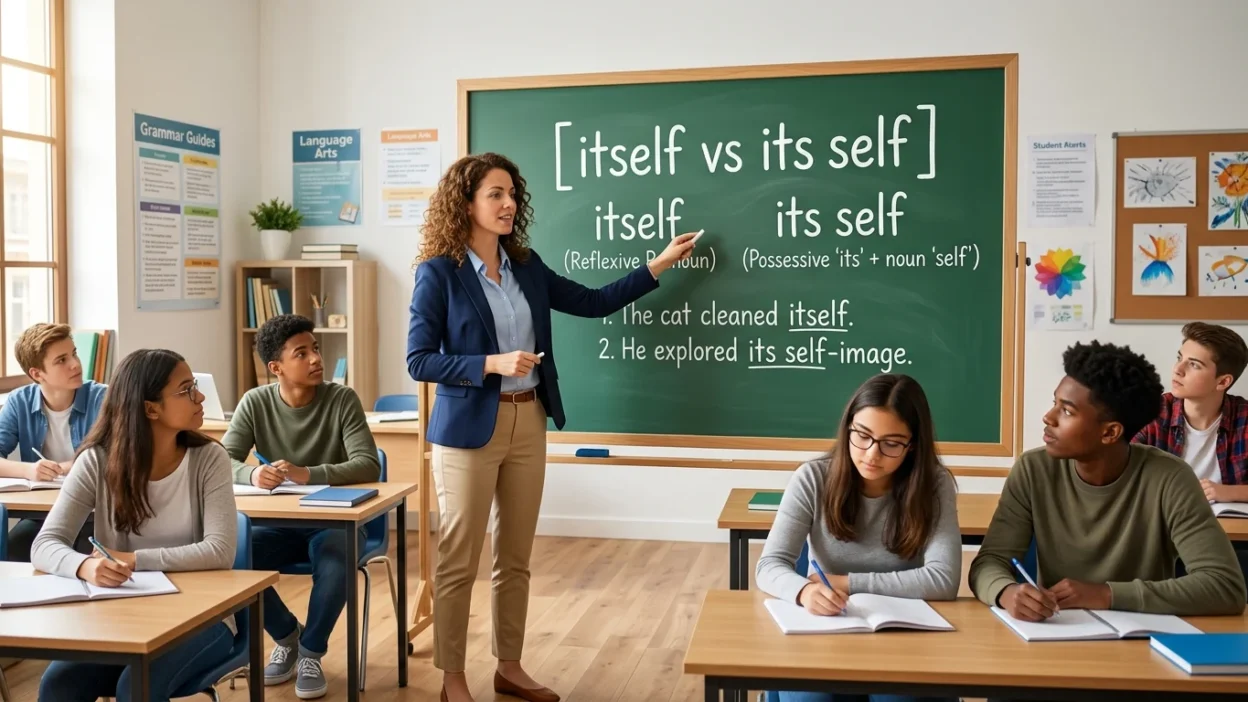
The words itself and its self look almost identical, but they are not normally interchangeable. For most everyday English sentences, itself is the correct form. It is a reflexive or emphatic pronoun used when referring back to a thing, animal, organization or situation.
The two-word form its self is much less common. In ordinary writing, it is usually incorrect because its and self do not normally need to be separated. However, its self can occasionally be used when self is being treated as a separate noun, especially in philosophical, psychological or highly specialized writing. For standard English, itself is almost always the form you want.
Quick Answer
Use itself in normal English.
- ✅ Itself = Standard reflexive/emphatic pronoun.
- ⚠️ Its self = Rare and only appropriate when self is intentionally being used as a separate noun.
Examples:
- The machine repaired itself.
- The company itself made the decision.
- The animal cleaned itself.
Why People Confuse It
People confuse itself and its self because:
- Its and it’s are already commonly confused.
- Self can function as a noun.
- The two forms sound identical.
- Some philosophical or psychological writing uses self as a separate concept.
In ordinary English, however, the pronoun is written as one word:
it + self = itself
Itself
Itself is a reflexive pronoun and can also be used for emphasis.
Meaning
It refers back to a previously mentioned thing or entity.
It can mean:
- The thing previously mentioned.
- The thing acting on itself.
- The thing in its own nature or form.
- The thing alone or independently.
Examples
- The cat cleaned itself.
- The door opened by itself.
- The computer restarted itself.
- The company itself issued the statement.
- The problem will resolve itself.
Itself for Emphasis
Itself can also emphasize a noun.
- The CEO herself approved the plan.
- The company itself confirmed the news.
- The machine itself is not damaged.
In these sentences, itself adds emphasis.
Its Self
Its self consists of two separate words:
- Its = possessive determiner.
- Self = noun.
This construction is unusual in ordinary English.
You might encounter it when self is being discussed as a distinct concept.
For example:
- The machine’s self was discussed in the philosophical paper.
- The system was described as having an independent self.
However, these sentences would usually be rewritten to sound more natural.
In most cases, if you mean the reflexive pronoun, use itself.
Itself vs Its Self Comparison Table
| Feature | Itself | Its Self |
|---|---|---|
| Standard everyday English | ✅ Yes | ❌ Rare |
| Reflexive pronoun | ✅ Yes | ❌ No |
| Written as one word | ✅ Yes | ❌ No |
| Used for emphasis | ✅ Yes | ❌ Generally no |
| Refers back to a thing | ✅ Yes | ⚠️ Only in specialized contexts |
| Common in ordinary writing | ✅ Very common | ❌ Very uncommon |
When to Use Each
Use itself when:
- A thing acts on itself.
- You want to emphasize a thing.
- You are referring back to something already mentioned.
- You mean “the thing alone” or “the thing in its own nature.”
Examples:
- The dog hurt itself.
- The organization itself released the report.
- The device can turn itself off.
Use its self only when self is deliberately being used as a separate noun.
This is unusual and tends to occur in specialized discussions about identity, consciousness, psychology, or philosophy.
Examples (10+)
- The cat washed itself.
- The computer shut down by itself.
- The door opened itself. (Better: “The door opened by itself.”)
- The company itself confirmed the information.
- The machine can repair itself.
- The child accidentally hurt itself.
- The organization itself made the decision.
- The problem may correct itself over time.
- The device automatically updates itself.
- The building itself is quite old.
- The system can monitor itself.
- The concept of the self is central to the discussion.
Notice that the final example uses self as an ordinary noun. It does not mean the same thing as itself.
Common Mistakes
❌ The machine repaired its self.
✅ The machine repaired itself.
❌ The company its self announced the decision.
✅ The company itself announced the decision.
❌ The dog cleaned its self.
✅ The dog cleaned itself.
Also remember that its and it’s are different:
- Its = possessive.
- It’s = it is or it has.
Example:
- The company changed its policy.
- It’s changing its policy.
Memory Trick
Use this simple rule:
If “it” is referring back to itself, write “itself” as one word.
Think:
It + self = itself
Just like:
- Myself
- Yourself
- Himself
- Herself
- Ourselves
- Themselves
These reflexive pronouns are written as single words.
American vs British English
There is no significant difference between American and British English.
Both varieties use itself as the standard reflexive and emphatic pronoun.
The unusual construction its self may appear in specialized philosophical or academic contexts, but it is not a normal alternative to itself.
Similar Words
If you’re learning commonly confused English words and phrases, you may also like:
- That’s vs Thats
- In Front vs Infront
- Its vs It’s
- Who’s vs Whose
- Your vs You’re
- Then vs Than
- Too vs To
Final Verdict
For almost every ordinary English sentence, itself is the correct choice. It is the standard reflexive and emphatic pronoun used to refer back to a thing or entity.
Its self is not normally an alternative spelling of itself. It can occasionally appear when self is intentionally being used as a separate noun, but this is unusual and specialized. If you’re simply trying to say that something did something to itself or emphasize the thing itself, use itself.
FAQs
Which is correct: “itself” or “its self”?
Itself is correct in normal English when you need the reflexive or emphatic pronoun.
Is “its self” grammatically correct?
It can be grammatical in rare contexts where self is being used as a separate noun, but it is not normally used as an alternative to itself.
Is “itself” one word?
Yes. Itself is always written as one word when it functions as the reflexive or emphatic pronoun.
Can I say “the machine repaired its self”?
No. If you mean the machine repaired the machine, write:
The machine repaired itself.
What is the difference between “its” and “itself”?
Its is a possessive determiner, while itself is a reflexive or emphatic pronoun.
Example:
- The company changed its policy.
- The company itself changed the policy.
Is “itself” used in American and British English?
Yes. Itself is standard in both varieties of English.
Conclusion
The distinction between itself and its self is straightforward once you understand their grammatical roles. Itself is the standard one word reflexive and emphatic pronoun, while its self is a rare construction in which self functions as a separate noun.
For everyday conversations, emails, articles, academic writing and professional communication, choose itself whenever you mean that a thing refers back to itself. This simple rule will help you avoid an unnecessary spelling and grammar mistake.
Remember This
✅ Itself = Standard reflexive pronoun
⚠️ Its self = Rare, specialized construction
Think: It + self = itself.