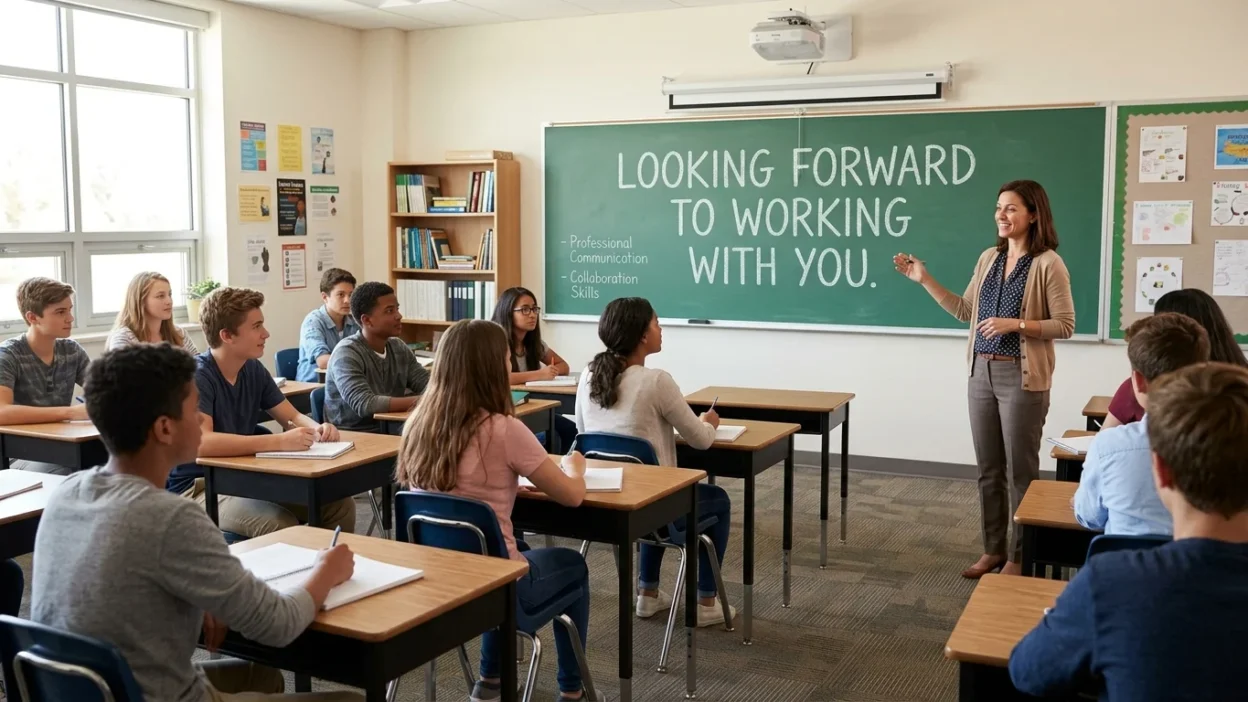
The phrase “looking forward to working with you” is a common and professional expression used when you are happy or excited about the opportunity to work with someone in the future. It is especially common in business emails, workplace communication, professional introductions, and messages to new clients or colleagues.
The phrase is grammatically correct because to in “looking forward to” is a preposition, not part of an infinitive. Therefore, it should be followed by a noun, pronoun, or gerund (-ing form). This is why we say “looking forward to working with you,” not “looking forward to work with you.”
Quick Answer
“Looking forward to working with you” means:
I am happy or excited about the opportunity to work with you in the future.
It is grammatically correct and appropriate for professional communication.
- ✅ I’m looking forward to working with you.
- ❌ I’m looking forward to work with you.
The correct form is working, because to is a preposition in the expression look forward to.
Why People Confuse It
The confusion comes from the word to.
Usually, to + verb forms an infinitive:
to work
to learn
to meet
to discuss
But in look forward to, to is a preposition. A preposition is followed by a noun, pronoun, or -ing form.
Therefore:
look forward to + working
not:
look forward to + work
Compare:
- I want to work with you. ✅
- I look forward to working with you. ✅
“Looking Forward to Working With You” Meaning
The phrase expresses positive anticipation about a future professional relationship.
For example:
Thank you for the opportunity. I’m looking forward to working with you.
This means:
I’m happy about the opportunity and anticipate working with you.
It can communicate:
- Enthusiasm
- Professional courtesy
- Positive expectations
- Willingness to collaborate
- Excitement about a future project
Is “Looking Forward to Working With You” Correct?
Yes, it is completely correct.
The full sentence is:
I’m looking forward to working with you.
The shorter version:
Looking forward to working with you.
is also common, especially in emails and casual professional messages. The subject I’m is simply omitted because it is understood from the context.
For formal writing, however, the complete version can sound slightly more polished:
I’m looking forward to working with you.
Looking Forward to Working With You vs. To Work With You
The correct expressions are:
I’m looking forward to working with you. ✅
and:
I’m excited to work with you. ✅
But don’t combine the structures incorrectly:
❌ I’m looking forward to work with you.
Why?
Because look forward to requires an -ing form after to.
Comparison Table
| Expression | Correct? | Meaning |
|---|---|---|
| Looking forward to working with you | ✅ | Anticipating working together |
| I’m looking forward to working with you | ✅ | Complete sentence |
| Looking forward to work with you | ❌ | Incorrect after “look forward to” |
| I’m excited to work with you | ✅ | Happy about working together |
| I look forward to working with you | ✅ | Formal/professional |
| I’m looking forward to our collaboration | ✅ | Professional alternative |
When to Use “Looking Forward to Working With You”
This phrase is particularly useful when:
Starting a New Job
I’m excited to join the team and looking forward to working with you.
Starting a New Project
Thank you for sharing the project details. I’m looking forward to working with you on this.
Beginning a Client Relationship
Thank you for choosing our services. We’re looking forward to working with you.
Meeting a New Colleague
It was great speaking with you. I’m looking forward to working with you.
Accepting a Business Opportunity
Thank you for the opportunity. I’m looking forward to working with you.
Examples (10+)
- I’m looking forward to working with you.
- We’re looking forward to working with you on this project.
- I’m really looking forward to working with you.
- It was great meeting you, and I’m looking forward to working with you.
- Thank you for the opportunity. I’m looking forward to working with you.
- We’re excited and looking forward to working with you.
- I’m looking forward to working with you and your team.
- I’m looking forward to working with you on this exciting project.
- Everyone here is looking forward to working with you.
- We’re looking forward to working with you in the coming months.
- I’m particularly looking forward to working with you on this initiative.
- It was a pleasure speaking with you, and I’m looking forward to working with you.
“Looking Forward to Working With You” in an Email
The phrase works particularly well near the end of a professional email.
For example:
Hi Sarah,
Thank you for sending the project details. Everything looks good, and I’m excited to get started.
I’m looking forward to working with you.
Best regards,
John
It can also be used in a shorter email:
Thank you for the opportunity. I’m looking forward to working with you.
Formal Alternatives
If you want to vary your wording, you can use:
- I look forward to working with you.
- I’m pleased to have the opportunity to work with you.
- I look forward to our collaboration.
- I’m excited about working with you.
- I look forward to collaborating with you.
- I’m delighted to be working with you.
- I look forward to working together.
“I Look Forward to Working With You”
This is slightly more formal and traditional than:
I’m looking forward to working with you.
It is especially common in professional emails and formal correspondence.
Common Mistakes
Mistake 1: “Looking forward to work with you”
❌ I’m looking forward to work with you.
✅ I’m looking forward to working with you.
Remember:
look forward to + -ing
Mistake 2: “Looking forward for working with you”
❌ I’m looking forward for working with you.
✅ I’m looking forward to working with you.
The fixed expression is look forward to.
Mistake 3: “Looking forward to working you”
❌ I’m looking forward to working you.
✅ I’m looking forward to working with you.
When you mean collaborating with someone, use work with.
Mistake 4: Thinking “to working” is incorrect
Some learners think to working must be grammatically wrong because they learned that to is followed by the base form of a verb.
But in look forward to, to is a preposition.
Therefore:
looking forward to working ✅
Memory Trick
Remember this formula:
LOOK FORWARD TO + NOUN / -ING
Examples:
- I look forward to the meeting.
- I look forward to meeting you.
- I look forward to our collaboration.
- I look forward to working with you.
So:
Look forward to + working ✅
Not:
Look forward to + work ❌
American vs British English
“Looking forward to working with you” is completely natural in both American and British English.
There is no significant difference in grammar or meaning.
Both varieties commonly use:
I’m looking forward to working with you.
and:
I look forward to working with you.
Similar Expressions
You may also want to know the difference between:
- Looking forward to seeing you
- Looking forward to meeting you
- Looking forward to hearing from you
- Looking forward to talking with you
- Looking forward to speaking with you
- Looking forward to working together
- Excited to work with you
- Looking forward to our collaboration
All of these can express positive anticipation, but the appropriate choice depends on the situation.
Final Verdict
“Looking forward to working with you” is correct, natural, and widely used in professional English.
The most important grammar point is that to in look forward to is a preposition. Therefore, it should be followed by working, not work.
Use:
✅ I’m looking forward to working with you.
You can also use the more formal:
✅ I look forward to working with you.
FAQs
Is “looking forward to working with you” grammatically correct?
Yes. It is grammatically correct and very common in professional English.
Is it “looking forward to work with you” or “looking forward to working with you”?
The correct form is:
Looking forward to working with you.
The expression look forward to is followed by a noun or -ing form.
Is “I’m looking forward to working with you” formal?
Yes. It is professional and appropriate for emails, workplace communication, clients, colleagues, and business situations.
Is “I look forward to working with you” better?
Both are correct. I look forward to working with you can sound slightly more formal, while I’m looking forward to working with you can sound warmer and more conversational.
Can I say “looking forward to working with you” in an email?
Yes. It is one of the most common ways to express enthusiasm about a future professional relationship.
What does “looking forward to working with you” mean?
It means you are happy or excited about the opportunity to work together in the future.
Can I say “looking forward for working with you”?
No. The standard expression is:
looking forward to working with you
not looking forward for working with you.
Is “looking forward to working together” correct?
Yes. Looking forward to working together is a natural alternative when both people are involved in the same project or activity.
Conclusion
“Looking forward to working with you” is a correct and professional expression that communicates positive anticipation about collaborating with someone. It works well in emails, business communication, workplace conversations and professional introductions.
The key grammar rule is simple: look forward to is followed by a noun or an -ing form. Therefore, “looking forward to working with you” is correct, while “looking forward to work with you” is not.
Remember This
✅ I’m looking forward to working with you.
✅ I look forward to working with you.
❌ I’m looking forward to work with you.
Quick rule: Look forward to + -ing → looking forward to working.