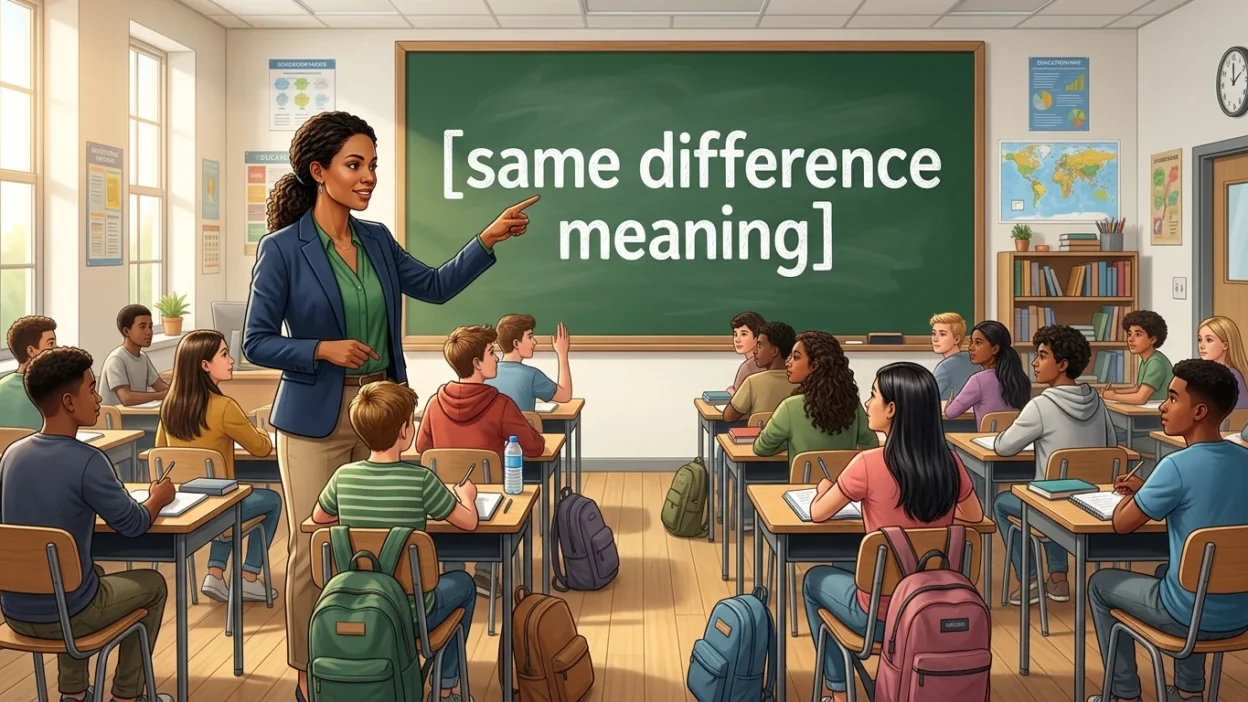
The phrase “same difference” may sound contradictory at first. After all, same suggests that two things are alike, while difference suggests that they are not. Yet “same difference” is a common informal expression used in English to say that two alternatives may be technically different but the distinction does not really matter to the speaker. It is often used when two choices lead to essentially the same result.
For example, if someone says, “We can take the bus or the train it’s the same difference,” they mean that either option is acceptable because the outcome is not important enough to worry about. The expression can be casual, humorous, sarcastic or dismissive depending on the context. It is especially common in conversation and informal writing, but it is generally not suitable for formal academic or professional writing.
Quick Answer: What Does “Same Difference” Mean?
“Same difference” means that two things are technically different, but the difference between them does not matter in the particular situation. It is an informal expression meaning something like “it makes no difference,” “either way” or “the result is basically the same.”
Why Do People Say “Same Difference”?
The phrase is an example of intentional contradiction.
The words same and difference normally express opposite ideas:
- Same = alike or identical
- Difference = a way in which things are unlike
Put together, “same difference” sounds logically contradictory. That’s part of what makes the expression humorous and memorable.
When people use it, they usually mean:
“Yes, there is a difference, but that difference isn’t important.”
For example:
“You can call me tomorrow or Friday. Same difference.”
The speaker recognizes that tomorrow and Friday are different days but considers the choice unimportant.
What Does “Same” Mean?
Same means identical or not different in the relevant respect.
Examples:
- We ordered the same meal.
- They are wearing the same shoes.
- We arrived at the same time.
In “same difference,” however, same does not literally mean that the two things are identical. Instead, it helps convey the idea that the practical effect of the difference is insignificant.
What Does “Difference” Mean?
Difference refers to the way two things are unlike each other.
For example:
- There is a big difference between the two plans.
- What’s the difference between these words?
- The price difference is only a few dollars.
In “same difference,” the speaker acknowledges that a difference exists but treats it as unimportant.
Comparison Table
| Expression | Meaning | Tone |
|---|---|---|
| Same difference | The difference doesn’t really matter | Informal, sometimes humorous |
| It makes no difference | The choice has no important effect | Neutral |
| Either way | Both options are acceptable | Neutral |
| No matter | The distinction is unimportant | Informal |
| Six of one, half a dozen of the other | Two alternatives are essentially equivalent | Informal, idiomatic |
| It doesn’t matter | The choice or distinction is unimportant | Neutral |
When to Use “Same Difference”
Use “same difference” when two alternatives are technically different but equivalent for the purpose being discussed.
Example 1: Choosing a day
“Should we meet on Tuesday or Wednesday?”
“Same difference to me.”
The speaker doesn’t care which day is chosen.
Example 2: Choosing transportation
“Should we take the bus or the train?”
“Same difference. Either one gets us there.”
The methods differ, but the outcome is essentially the same.
Example 3: Choosing a word
“Do you want me to say ‘start’ or ‘begin’?”
“Same difference.”
The speaker considers the distinction insignificant.
10+ Examples of “Same Difference”
- “We can go today or tomorrow. Same difference to me.”
- “You can email me or send me a message. Same difference.”
- “Take the blue one or the black one. Same difference.”
- “We could meet at six or seven. Same difference.”
- “Call it a mistake or an error—it’s the same difference.”
- “You can pay online or in person. Same difference.”
- “Whether we drive or take a taxi, it’s the same difference.”
- “He can come now or later. Same difference to me.”
- “You can use either spelling in this context. Same difference.”
- “We can watch the movie tonight or tomorrow. Same difference.”
- “Choose whichever restaurant you prefer. Same difference as far as I’m concerned.”
- “You call it a problem or a challenge same difference.”
Is “Same Difference” Sarcastic?
It can be sarcastic, but it isn’t always sarcastic.
Its tone depends heavily on context and delivery.
Neutral or casual
“Tea or coffee? Same difference to me.”
This simply means the speaker doesn’t have a preference.
Sarcastic
“You forgot the meeting was today, not tomorrow?”
“Same difference.”
Here, the phrase may sound dismissive or sarcastic because the two days actually matter.
So, “same difference” can communicate indifference, humor or sarcasm.
Is “Same Difference” Correct English?
Yes. “Same difference” is an established informal expression.
It is not normally used as a literal logical statement. Instead, it is an idiomatic way of saying that a distinction is not important in the circumstances.
For formal writing, however, clearer alternatives are usually preferable:
- It makes no difference.
- Either option is acceptable.
- The distinction is insignificant.
- The outcome is essentially the same.
“Same Difference” vs “It Makes No Difference”
These expressions are similar, but their tone differs.
“It makes no difference” is straightforward and can be used in both casual and relatively formal contexts.
“It makes no difference which option you choose.”
“Same difference” is more conversational and often has a playful or humorous quality.
“Choose either one. Same difference.”
For professional or academic writing, “it makes no difference” is usually the better choice.
“Same Difference” vs “Six of One, Half a Dozen of the Other”
These expressions are closely related.
“Same difference” means the distinction between two alternatives is not important.
“Six of one, half a dozen of the other” means two choices are essentially equivalent.
For example:
“We can leave at six or seven. Same difference.”
And:
“You can choose either option. It’s six of one, half a dozen of the other.”
The second expression is more colorful and old-fashioned, while “same difference” is shorter and more casual.
Common Mistakes
1. Thinking it means “exactly the same”
It usually doesn’t.
“Same difference” does not necessarily mean two things are identical. It means their difference doesn’t matter in the situation.
2. Using it in formal writing
The expression is informal. In an academic paper or formal report, use:
“The distinction is insignificant.”
rather than:
“Same difference.”
3. Assuming it is always sarcastic
It can be sarcastic, but it can also be completely casual.
4. Thinking “same difference” is grammatically literal
The phrase works idiomatically rather than as a literal description of two identical differences.
Is “Same Difference” Rude?
Not inherently.
However, it can sound dismissive if someone is trying to explain an important distinction to you.
For example:
“There is a significant legal difference between these two agreements.”
“Same difference.”
In this situation, the response could sound disrespectful because the speaker is dismissing a distinction that the other person considers important.
When the distinction genuinely doesn’t matter, the expression is usually harmless.
American vs British English
“Same difference” is understood in both American and British English.
It is informal in both varieties and can be used conversationally to indicate that two alternatives are effectively equivalent.
The expression is not generally preferred in formal writing in either variety.
Similar Expressions
Depending on the context, you can use:
- It makes no difference.
- Either way.
- It doesn’t matter.
- No difference to me.
- Either one is fine.
- The outcome is the same.
- Six of one, half a dozen of the other.
- What’s the difference?
- It amounts to the same thing.
- They’re essentially equivalent.
Memory Trick
Remember:
Same difference = Different, but it doesn’t matter.
The two things may not literally be the same, but the difference between them is unimportant.
Think:
“Different options, same practical result.”
FAQs About “Same Difference”
1. What does “same difference” mean?
It means two things are different in some way, but the difference does not matter in the situation.
2. Is “same difference” an idiom?
Yes. It is an informal idiomatic expression used to dismiss or minimize a distinction between two alternatives.
3. Is “same difference” sarcastic?
It can be sarcastic, but it can also be used casually to express indifference.
4. Is “same difference” grammatically correct?
Yes, as an established informal expression. However, it should not be interpreted as a literal statement that two differences are identical.
5. Is “same difference” formal English?
No. It is generally considered informal or conversational. In formal writing, use “it makes no difference” or “the distinction is insignificant.”
6. What is another way to say “same difference”?
You can say “it makes no difference,” “either way,” “it doesn’t matter,” or “either option is fine.”
7. Does “same difference” mean exactly the same?
No. It usually means that two things are different but equivalent or equally acceptable for the purpose at hand.
8. Can I use “same difference” at work?
You can use it in casual workplace conversation, but avoid it in formal reports, presentations, or professional writing where a clearer phrase would be better.
Final Verdict
“Same difference” is an informal English expression meaning that two things may be different, but the difference is not important or does not affect the outcome. It is often used when someone doesn’t have a preference between two choices.
Although the phrase sounds contradictory, that contradiction is intentional and gives the expression its humorous, conversational character. Use it freely in casual conversation, but choose clearer alternatives such as “it makes no difference” in formal or professional writing.
Remember This
Same difference = The things are different, but the difference doesn’t matter.
- Meaning: Essentially equivalent or equally acceptable
- Tone: Informal, conversational, sometimes humorous or sarcastic
- Formal alternative: “It makes no difference.”
- Similar expression: “Six of one, half a dozen of the other”
- Key idea: Different options, same practical result

Oliver Owen is the dedicated administrator of MeanHives, ensuring smooth daily operations, maintaining content quality, supporting users, organizing educational resources, and helping learners confidently improve their English vocabulary and word-matching skills.