
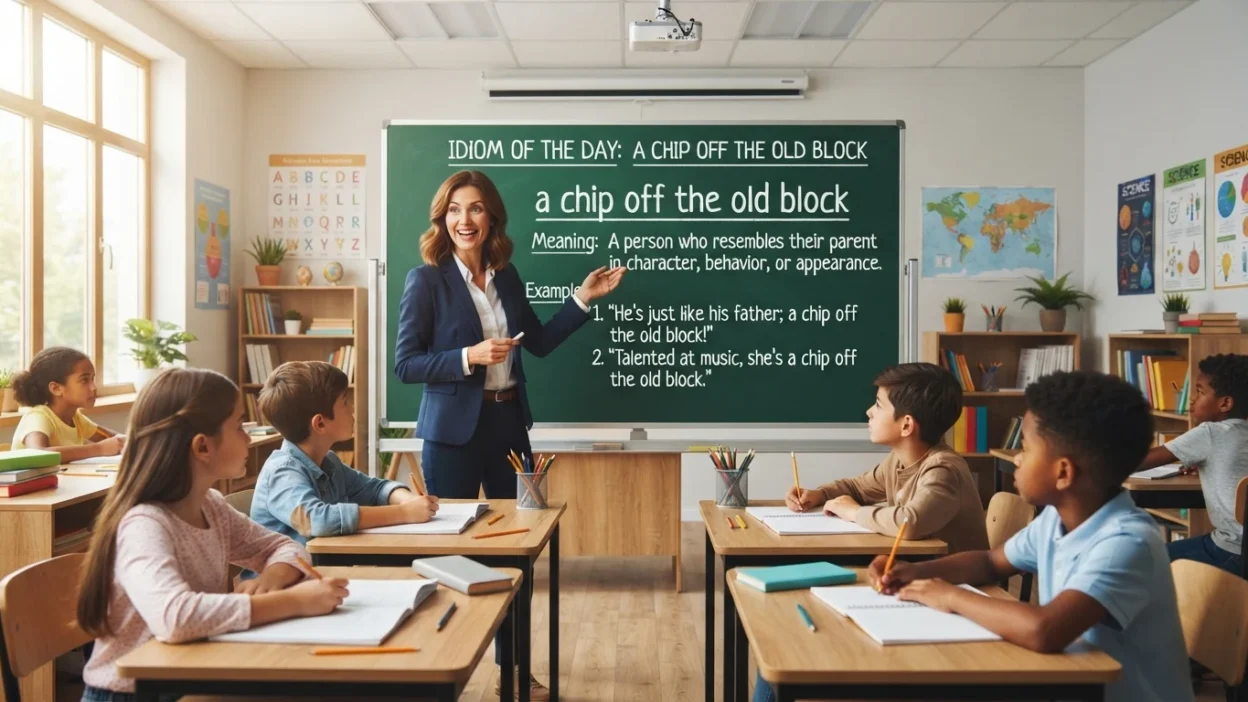
Have you ever noticed that a son, daughter or younger family member behaves remarkably like one of their parents?
Perhaps they have the same personality, talents, habits, sense of humor or even mannerisms. In English, there is a popular idiom for this: “a chip off the old block.” The expression describes someone who is very similar to one of their parents, usually because they share characteristics, abilities or personality traits.
The phrase is commonly used as a compliment, especially when a child demonstrates qualities that resemble those of a parent. For example, if a talented musician has a child who becomes an excellent musician too, someone might say, “She’s a chip off the old block.” The idiom is informal and conversational, making it especially common in everyday speech, family conversations, sports, entertainment, and informal writing.
Quick Answer
“A chip off the old block” means a person who is very similar to their parent, especially in personality, appearance, behavior, skills or talents. It usually suggests that the child has inherited qualities from a parent. For example, “He’s a chip off the old block” means he is very much like his father.
Why Do People Say “A Chip Off the Old Block”?
The expression uses a simple physical image.
Imagine a block of wood or stone. If a small piece, or “chip,” is broken off the larger block, the chip is made from the same material as the original.
Figuratively, the “old block” represents the parent, while the “chip” represents the child.
So, a “chip off the old block” is someone who resembles the person they came from.
The phrase usually refers to similarities such as:
- Personality
- Appearance
- Behavior
- Talents
- Skills
- Interests
- Habits
- Attitudes
- Sense of humor
What Does “A Chip Off the Old Block” Mean?
A chip off the old block means someone who is very much like their parent.
For example:
“Tom is a chip off the old block.”
This means Tom has qualities similar to those of his parent, often his father.
The similarity can be positive or neutral, depending on the context.
Example
“Her mother is an excellent artist, and she became an artist too. She’s a chip off the old block.”
The speaker is saying that the daughter’s artistic talent resembles her mother’s.
Is “A Chip Off the Old Block” an Idiom?
Yes. “A chip off the old block” is a common English idiom.
Its meaning is figurative rather than literal.
You normally are not saying that someone is literally a piece of wood or stone. Instead, you are saying that the person closely resembles a parent.
Literal meaning
“A chip broke off the old block of wood.”
Here, “chip” has its literal meaning.
Idiomatic meaning
“She’s a chip off the old block.”
Here, the phrase means she is very much like her parent.
When to Use “A Chip Off the Old Block”
Use this idiom when someone has noticeably inherited or developed characteristics similar to those of a parent.
It can describe:
Personality
“He’s just as patient as his father—a chip off the old block.”
Talent
“Her mother is a gifted singer, and she’s a chip off the old block.”
Appearance
“Look at that smile! He’s a chip off the old block.”
Behavior
“He has the same adventurous personality as his dad. He’s a chip off the old block.”
Interests
“His father loves fishing, and now he does too. He’s a chip off the old block.”
12 Examples of “A Chip Off the Old Block”
- Jake is a chip off the old block; he’s just as hardworking as his father.
- She became a successful lawyer like her mother—a real chip off the old block.
- He has his father’s sense of humor. He’s definitely a chip off the old block.
- The young athlete is a chip off the old block. His father was a professional player too.
- She’s inherited her mother’s artistic talent. She’s a chip off the old block.
- Everyone says he’s a chip off the old block because he looks and acts just like his dad.
- His daughter loves cooking just as much as he does. She’s a chip off the old block.
- Like his father, he has always been interested in mechanics. He’s a chip off the old block.
- The boy has the same adventurous spirit as his mother—a chip off the old block.
- She has her father’s determination and her mother’s creativity, so she’s quite a chip off the old block.
- He followed his father’s footsteps and became a teacher. He’s a chip off the old block.
- Everyone laughed when he told the same jokes his father used to tell. He’s certainly a chip off the old block.
Does “A Chip Off the Old Block” Mean “Like Father, Like Son”?
They have very similar meanings, but they are not exactly identical.
“Like father, like son” specifically compares a son with his father.
“A chip off the old block” is broader and can describe a child who resembles either parent.
For example:
- Like father, like son. → Specifically father and son.
- She’s a chip off the old block. → She resembles her parent.
You can use “chip off the old block” for daughters as well as sons.
A Chip Off the Old Block vs. Like Father, Like Son
| Expression | Meaning | Usage |
|---|---|---|
| A chip off the old block | Someone resembles their parent | Can apply to sons or daughters |
| Like father, like son | A son resembles his father | Specifically father and son |
| Like mother, like daughter | A daughter resembles her mother | Specifically mother and daughter |
| Take after someone | Resemble someone, usually a family member | Very common everyday English |
| Follow in someone’s footsteps | Follow a person’s career, lifestyle, or example | Focuses on actions or choices |
“A Chip Off the Old Block” vs “Take After”
These expressions are closely related.
Take after someone means to resemble them in appearance, personality, behavior, or other characteristics.
“She takes after her mother.”
A chip off the old block emphasizes that the child is very much like the parent.
“She’s a chip off the old block.”
Both are natural, but “take after” is generally more flexible in everyday conversation.
Common Mistakes
1. Saying “a chip from the old block”
The established idiom is:
A chip off the old block
Not:
A chip from the old block
“Off” is an important part of the traditional expression.
2. Thinking it only applies to sons
It does not.
You can say:
“She’s a chip off the old block.”
The idiom can describe anyone who resembles a parent.
3. Assuming it only refers to appearance
The phrase can describe much more than physical appearance.
Someone can be a chip off the old block because of their:
- Personality
- Talent
- Behavior
- Work ethic
- Interests
- Sense of humor
- Attitude
4. Confusing it with “follow in someone’s footsteps”
These expressions overlap, but follow in someone’s footsteps usually means following someone’s career, lifestyle, or example.
“He followed in his father’s footsteps and became a doctor.”
Being a chip off the old block focuses more broadly on similarity.
Memory Trick
Think of a block of wood.
A small chip comes off the original block.
The chip is made from the same material as the block.
So:
Chip = child
Old block = parent
Same material = similar qualities
Therefore:
A chip off the old block = a child who is very much like a parent.
Is “A Chip Off the Old Block” Positive?
Usually, yes.
The expression is often used as a compliment.
For example:
“Her father is an excellent chef and she’s a chip off the old block.”
This suggests that she inherited or developed her father’s excellent cooking abilities.
However, context matters. If the parent has an undesirable habit, the expression can be used negatively or humorously.
“He’s a chip off the old block always getting into trouble just like his father.”
So the idiom itself is not inherently positive or negative.
American vs. British English
“A chip off the old block” is used in both American and British English.
The meaning is essentially the same in both varieties.
It is an informal, familiar idiom and can be found in everyday conversation, journalism, entertainment, and other informal contexts.
There is no major American versus British spelling difference for this expression.
Similar Words and Expressions
Take after
To resemble a family member.
“She takes after her mother.”
Resemble
To look or be similar to someone.
“He strongly resembles his father.”
Like father, like son
A son has characteristics similar to his father.
Like mother, like daughter
A daughter has characteristics similar to her mother.
Follow in someone’s footsteps
To follow someone’s career, example, or lifestyle.
Run in the family
A characteristic, talent, behavior or condition is common among family members.
“Musical talent runs in the family.”
Frequently Asked Questions
What does “a chip off the old block” mean?
It means someone who is very similar to their parent in appearance, personality, behavior, talents, or other characteristics.
Is “a chip off the old block” a compliment?
Usually, yes. It is commonly used positively to praise a child for sharing desirable qualities with a parent. However, context can make it humorous or negative.
Can you say “she is a chip off the old block”?
Yes. The expression can describe both males and females.
“She’s a chip off the old block.”
What is another way to say “a chip off the old block”?
Common alternatives include “take after someone,” “like father, like son,” “like mother, like daughter,” and “resemble a parent.”
What is the origin of “a chip off the old block”?
The expression comes from the literal image of a small piece, or chip, breaking off a larger block of wood or stone. The chip is made from the same material as the original block, creating the metaphor for a child resembling a parent.
Is “a chip off the old block” formal or informal?
It is generally informal and conversational. It is perfectly natural in everyday English but may be replaced by “resembles a parent” in highly formal or academic writing.
Does “a chip off the old block” only refer to fathers?
No. It can refer to someone who resembles either parent, although traditional examples often associate it with a father and son.
Final Verdict
“A chip off the old block” is an English idiom used to describe someone who is very similar to their parent. The similarity can involve appearance, personality, talents, interests, behavior or other characteristics.
It is usually a positive expression and is often used when a child demonstrates the same qualities or abilities as a parent. Remember that the phrase is “a chip off the old block,” not “a chip from the old block.”
Remember This
A chip off the old block = someone who is very much like their parent.
Think of a small piece of wood coming from the same block: same source, similar qualities.
Conclusion
“A chip off the old block” is a useful and colorful idiom for talking about family resemblance. Unlike expressions that focus only on physical appearance, it can describe personality, talents, interests, habits, behavior and many other characteristics inherited or shared between parents and children.
When someone says “He’s a chip off the old block,” they are usually pointing out that the person strongly resembles a parent. Whether the similarity is about a great talent, a familiar personality trait or even a funny habit, the idiom adds a natural and expressive touch to everyday English.

Oliver Owen is the dedicated administrator of MeanHives, ensuring smooth daily operations, maintaining content quality, supporting users, organizing educational resources, and helping learners confidently improve their English vocabulary and word-matching skills.