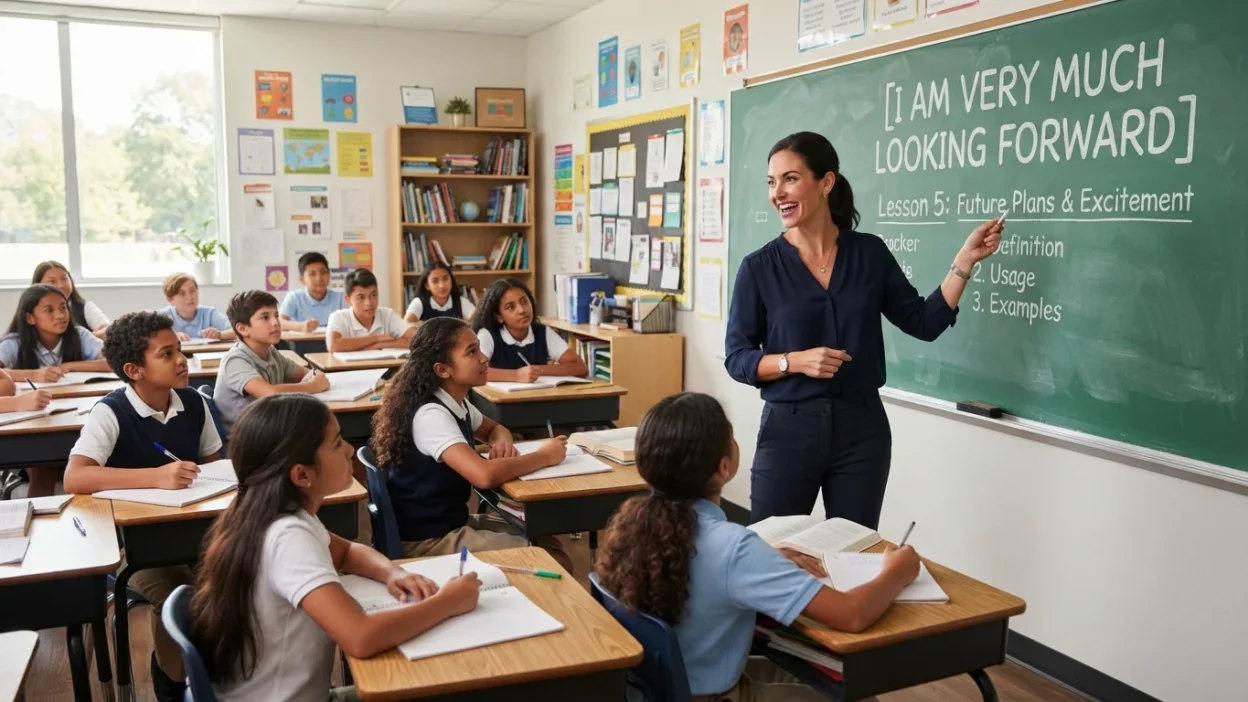
The phrase “I am very much looking forward” is a common expression used to show that you are excited, eager or anticipating something positively. It is especially common in professional emails, personal messages, invitations, announcements and everyday conversations. However, many English learners wonder whether the phrase is grammatically complete on its own or whether it needs something after it.
The answer is simple: “I am very much looking forward” is grammatically correct, but it normally needs a complement after it. Most commonly, we say “I am very much looking forward to…” followed by a noun, noun phrase, or -ing form of a verb. For example, “I am very much looking forward to meeting you” is correct. The phrase expresses strong positive anticipation and is slightly more emphatic than simply saying “I am looking forward to…”
Quick Answer
“I am very much looking forward to…” is correct English and means that you are very excited or eager about something that is going to happen. Use “to” + a noun or -ing verb, such as “I am very much looking forward to the event” or “I am very much looking forward to seeing you.”
What Does “I Am Very Much Looking Forward” Mean?
The phrase means:
I am very excited or eager about something that I expect to happen.
For example:
I am very much looking forward to meeting you.
This means:
I am very excited about meeting you.
The expression communicates positive anticipation.
The word “very much” adds emphasis. Compare:
- I am looking forward to the trip.
- I am very much looking forward to the trip.
Both are correct, but the second expresses stronger enthusiasm.
Is “I Am Very Much Looking Forward” Correct?
Yes, but there is an important grammatical point.
“I am very much looking forward” usually sounds incomplete if nothing follows it.
The standard construction is:
I am very much looking forward to + noun / -ing form
For example:
- I am very much looking forward to the conference.
- I am very much looking forward to meeting you.
- I am very much looking forward to working with you.
- I am very much looking forward to hearing from you.
So, while “I am very much looking forward” is grammatically possible in a context where the object is already understood, the complete and natural expression is usually “I am very much looking forward to…”
Why Is “Looking Forward To” Followed by -ing?
One of the most important grammar rules is that “to” in “look forward to” is a preposition, not the infinitive marker.
Therefore, when a verb follows it, use the -ing form.
Correct
I am looking forward to meeting you.
Incorrect
I am looking forward to meet you.
Correct
I am looking forward to working with you.
Incorrect
I am looking forward to work with you.
This rule applies whether or not you include “very much.”
I Am Very Much Looking Forward To + Examples
Here are natural examples:
- I am very much looking forward to meeting you.
- I am very much looking forward to seeing you again.
- I am very much looking forward to working with your team.
- I am very much looking forward to the conference.
- I am very much looking forward to hearing from you.
- I am very much looking forward to starting this new project.
- I am very much looking forward to your visit.
- I am very much looking forward to discussing the proposal with you.
- I am very much looking forward to the opportunity.
- I am very much looking forward to spending time with everyone.
- I am very much looking forward to learning more about the program.
- I am very much looking forward to joining the team.
“I Am Very Much Looking Forward To Meeting You”
This is one of the most useful forms of the expression.
I am very much looking forward to meeting you.
It means:
I am very excited about meeting you.
It is appropriate for:
- Job interviews
- Professional meetings
- Introductions
- Business correspondence
- Networking
- Formal invitations
For example:
Thank you for arranging the interview. I am very much looking forward to meeting you.
This sounds polite, positive, and professional.
“I Am Very Much Looking Forward To Working With You”
This is also extremely common in professional English.
I am very much looking forward to working with you.
It expresses enthusiasm about beginning a professional relationship.
For example:
Thank you for the opportunity. I am very much looking forward to working with you and your team.
Notice that working, not work, follows “to.”
“I Am Very Much Looking Forward To Seeing You”
This expression is natural when talking about a future meeting or reunion.
I am very much looking forward to seeing you next week.
It means that you are excited about seeing the person.
The same structure applies:
looking forward to + seeing
Not:
looking forward to see
Comparison Table
| Expression | Meaning | Usage |
|---|---|---|
| I am looking forward to… | I am anticipating something positively | Neutral and common |
| I am very much looking forward to… | I am strongly anticipating something | More emphatic |
| I am really looking forward to… | I am very excited about something | Natural and conversational |
| I am eagerly looking forward to… | I am anticipating something with eagerness | More formal/literary |
| I look forward to… | I anticipate something positively | Formal/professional |
| I can’t wait to… | I am extremely excited | Informal |
| I am excited about… | I feel enthusiastic about something | General |
| I anticipate… | I expect something to happen | Formal |
“I Am Very Much Looking Forward” vs. “I Look Forward”
Both are correct, but they are commonly used in different contexts.
I am very much looking forward to…
This uses the present progressive and often sounds warm and enthusiastic.
I am very much looking forward to meeting you.
I look forward to…
This is especially common in formal and professional communication.
I look forward to meeting you.
For example, at the end of an email:
I look forward to hearing from you.
This is a standard professional closing expression.
“I Am Very Much Looking Forward To” vs. “I Am Really Looking Forward To”
Both are correct.
Very much
I am very much looking forward to the event.
This can sound slightly more formal or polished.
Really
I am really looking forward to the event.
This sounds more conversational and natural in everyday speech.
Both communicate strong anticipation.
Is “Very Much Looking Forward” Formal?
It can be used in both formal and informal contexts.
For example, in a professional email:
I am very much looking forward to working with you.
In a personal message:
I am very much looking forward to seeing everyone this weekend.
However, “I’m really looking forward to…” is generally more conversational.
Common Mistakes
1. “Looking forward to meet you”
❌ I am looking forward to meet you.
✅ I am looking forward to meeting you.
Because “to” is a preposition in this expression, use the -ing form.
2. “Looking forward to see you”
❌ I am very much looking forward to see you.
✅ I am very much looking forward to seeing you.
3. “I am looking forward for…”
❌ I am looking forward for meeting you.
✅ I am looking forward to meeting you.
The fixed expression is look forward to, not look forward for.
4. “I very much look forward to…”
This is actually correct.
I very much look forward to hearing from you.
The position of “very much” can vary depending on the structure.
5. Forgetting “to”
❌ I am very much looking meeting you.
✅ I am very much looking forward to meeting you.
The full expression is look forward to.
When to Use “I Am Very Much Looking Forward To”
Use this phrase when you want to communicate strong positive anticipation.
It works particularly well when:
- Meeting someone
- Starting a job
- Beginning a project
- Attending an event
- Receiving something
- Visiting someone
- Hearing from someone
- Working with someone
- Discussing something
For example:
I am very much looking forward to our meeting.
This sounds professional and enthusiastic without being overly informal.
American vs British English
“I am very much looking forward to…” is correct in both American and British English.
There is no meaningful regional difference in the grammar.
Both varieties use:
look forward to + noun
and
look forward to + -ing verb
For example:
I am looking forward to the weekend.
I am looking forward to seeing you.
The construction is standard in both varieties.
Similar Expressions
I am really looking forward to…
A natural, conversational alternative.
I am really looking forward to the trip.
I can’t wait to…
A stronger and more informal expression.
I can’t wait to see you.
I am excited about…
A straightforward way to express enthusiasm.
I am excited about starting the new job.
I eagerly anticipate…
A more formal expression.
I eagerly anticipate the opportunity to work with you.
I look forward to…
A standard professional expression.
I look forward to hearing from you.
Frequently Asked Questions
Is “I am very much looking forward” grammatically correct?
Yes, but it is normally followed by “to” plus a noun or -ing form. For example, “I am very much looking forward to meeting you.”
Is it correct to say “I am very much looking forward to meeting you”?
Yes. This is completely correct and is a polite, enthusiastic expression commonly used in professional and personal communication.
Should I say “looking forward to meet” or “looking forward to meeting”?
Use “looking forward to meeting.” The word “to” is a preposition in the expression “look forward to,” so a following verb takes the -ing form.
Is “I am very much looking forward to” formal?
It can sound polished and professional, but it is not restricted to formal English. It can also be used in personal communication.
What is the difference between “I look forward to” and “I am looking forward to”?
Both express positive anticipation. “I look forward to” is particularly common in formal and professional writing, while “I am looking forward to” often sounds more personal and conversational.
Can I say “I am very much looking forward to hearing from you”?
Yes. It is grammatically correct and commonly used in professional emails.
Is “I am very much looking forward for” correct?
No. The standard expression is “I am very much looking forward to…”, not “looking forward for.”
Final Verdict
“I am very much looking forward to…” is correct and natural English. It expresses strong positive anticipation and is suitable for both professional and personal situations. The most important grammar rule is to use “to + noun” or “to + -ing verb.”
For example, say “I am very much looking forward to meeting you,” not “I am very much looking forward to meet you.” If you want a slightly more conversational tone, “I am really looking forward to…” is an excellent alternative.
Remember This
Look forward to + noun / -ing form
✅ I am very much looking forward to meeting you.
✅ I am very much looking forward to the event.
❌ I am very much looking forward to meet you.
❌ I am very much looking forward for meeting you.
The key is simple: “look forward to” → “to” is followed by a noun or -ing verb.
Conclusion
“I am very much looking forward to” is a useful expression for showing enthusiasm about something that is expected to happen. It is grammatically correct, polite, and natural in a wide range of situations, from professional emails to personal conversations.
The most important point to remember is the structure “look forward to + noun or -ing.” Once you remember that “to” is a preposition in this expression, choosing the correct form becomes easy. So you can confidently write “I am very much looking forward to meeting you,” “I am very much looking forward to working with you,” or “I am very much looking forward to the event.”
Oliver Owen is the dedicated administrator of MeanHives, ensuring smooth daily operations, maintaining content quality, supporting users, organizing educational resources, and helping learners confidently improve their English vocabulary and word-matching skills.