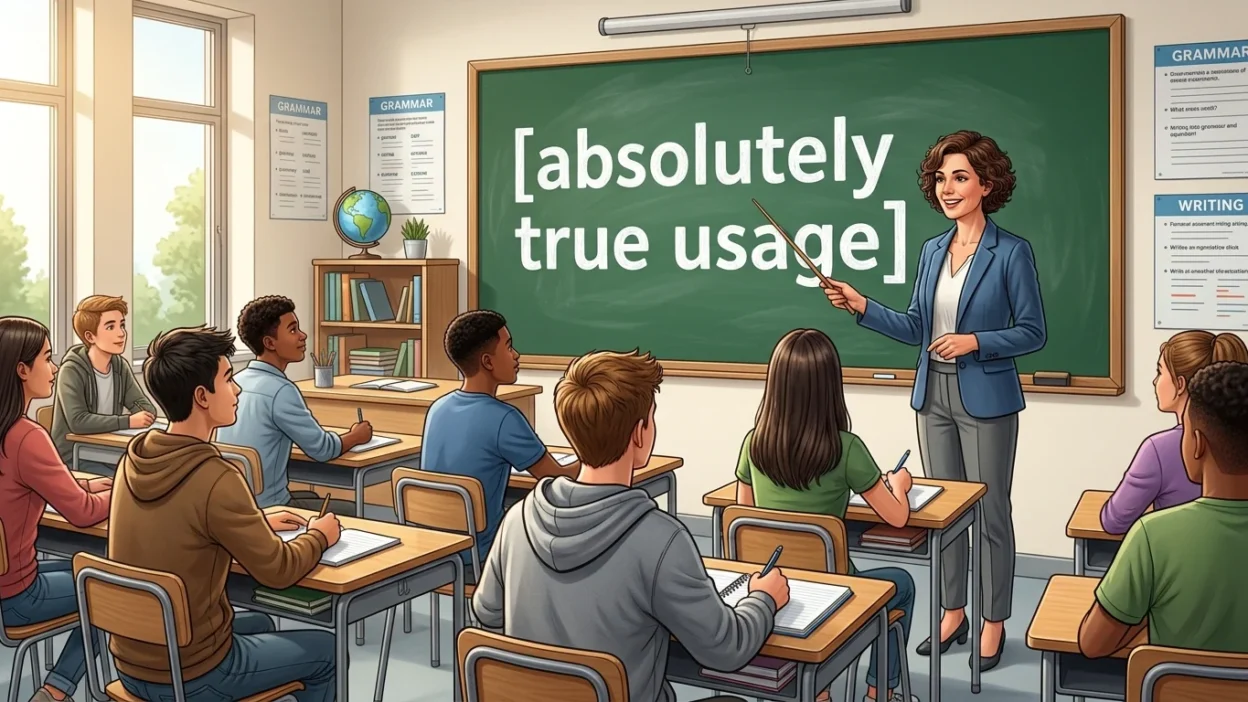
The phrase absolutely true is a common expression in English used to emphasize that something is completely, unquestionably or entirely true. You’ll hear it in everyday conversations, debates, journalism and professional communication when speakers want to stress the certainty of a statement.
Some learners wonder whether absolutely true is grammatically correct because true already expresses a complete idea. While some style experts suggest that true is an absolute adjective and doesn’t technically need an intensifier, absolutely true is widely accepted in modern English. It adds emphasis rather than changing the meaning, making it a natural and effective expression in both spoken and written English.
Quick Answer
Yes, absolutely true is grammatically correct and commonly used.
It means:
- Completely true.
- Entirely accurate.
- Without any doubt.
Examples:
- ✅ That’s absolutely true.
- ✅ Her statement is absolutely true.
- ✅ It is absolutely true that exercise benefits your health.
Why People Confuse It
People question absolutely true because:
- True is often considered an absolute adjective, meaning something is either true or false.
- Some grammar guides discourage modifying absolute adjectives with words like very or quite.
- However, modern English frequently uses absolutely for emphasis with words such as true, certain, correct, and right.
As a result, absolutely true is widely accepted by dictionaries, writers, and native speakers.
Absolutely True
Absolutely true is an adjective phrase.
Meaning
It means:
- Completely true.
- Entirely factual.
- Beyond doubt.
- Perfectly accurate.
The adverb absolutely strengthens the certainty of true.
Examples
- That’s absolutely true.
- Everything she said was absolutely true.
- His claim turned out to be absolutely true.
- It is absolutely true that practice improves performance.
- The report is absolutely true according to the available evidence.
True
True is an adjective.
Meaning
It means:
- Correct.
- Accurate.
- In accordance with fact.
- Genuine.
It can stand alone without an intensifier.
Examples
- The statement is true.
- That’s true.
- The information is true.
- His explanation proved true.
- The story is based on true events.
Absolutely True vs True Comparison Table
| Feature | Absolutely True | True |
|---|---|---|
| Grammatically correct | ✅ Yes | ✅ Yes |
| Adds emphasis | ✅ Yes | ❌ No |
| Common in conversation | ✅ Very common | ✅ Very common |
| Suitable for formal writing | ✅ Yes | ✅ Yes |
| Expresses certainty | ✅ Strongly | ✅ Clearly |
When to Use Each
Use absolutely true when you want to:
- Emphasize certainty.
- Strongly agree with someone.
- Stress that a statement is completely accurate.
- Add rhetorical emphasis.
Examples:
- That’s absolutely true.
- Your observation is absolutely true.
Use true when:
- No extra emphasis is needed.
- Writing concise or neutral statements.
- Presenting factual information.
Examples:
- The statement is true.
- What she said is true.
Examples (10+)
- That’s absolutely true.
- Everything in the report is absolutely true.
- His statement proved absolutely true.
- It is absolutely true that experience matters.
- The accusation was not absolutely true.
- The story is true.
- Her answer was true.
- What you said is absolutely true.
- The evidence shows the claim is true.
- Your conclusion is absolutely true.
- That observation is absolutely true.
- The witness’s account was found to be true.
Common Mistakes
❌ Thinking absolutely true is grammatically incorrect.
✅ It is a widely accepted and natural expression.
❌ Using very true in highly formal writing when stronger precision is needed.
✅ Absolutely true or simply true often sounds more natural.
❌ Assuming absolutely true changes the factual meaning.
✅ It simply adds emphasis.
Memory Trick
Think of absolutely as a spotlight.
- True = Correct.
- Absolutely true = Correct beyond any doubt.
Ask yourself:
Do I want extra emphasis?
- Yes → Absolutely true
- No → True
American vs British English
There is no significant difference between American and British English.
Both varieties:
- Use absolutely true frequently.
- Accept it in conversation, journalism and professional writing.
- Use true alone when emphasis is unnecessary.
Similar Words and Expressions
If you’re improving your English vocabulary, you may also enjoy:
- Absolutely Correct vs. Correct
- Completely True vs. Entirely True
- In Fact
- Without a Doubt
- That’s Right vs. You’re Right
- Indeed
- Certainly
Final Verdict
Absolutely true is a grammatically correct and widely accepted expression in modern English. Although true is often described as an absolute adjective, native speakers regularly use absolutely to emphasize certainty and this usage is considered natural in both speech and writing.
If you simply want to state a fact, true is enough. If you want to highlight complete certainty or strongly agree with a statement, absolutely true is an excellent choice.
FAQs
Is “absolutely true” grammatically correct?
Yes. It is a correct and widely used expression in modern English.
Can “true” be modified by “absolutely”?
Yes. Although true is often considered an absolute adjective, absolutely true is accepted because absolutely adds emphasis.
Is “absolutely true” redundant?
Some style experts consider it rhetorically redundant, but in everyday English it is a natural and effective way to emphasize certainty.
Which is better: “true” or “absolutely true”?
Use true for neutral statements and absolutely true when you want stronger emphasis.
Can I use “absolutely true” in formal writing?
Yes. It is appropriate in most formal and professional contexts, although excessive emphasis should be avoided in highly technical writing.
Do American and British English use it differently?
No. Both varieties commonly use absolutely true with the same meaning.
Conclusion
The phrase absolutely true is a standard part of modern English and is used to express complete confidence in the accuracy of a statement. While true already indicates factual correctness, adding absolutely provides emphasis that can make your message sound more confident and persuasive.
In everyday conversation, business communication, and most forms of writing, absolutely true is perfectly acceptable. Use it when you want to underline certainty and use true alone when a simple factual statement is enough.
Remember This
✅ True = Factually correct
✅ Absolutely true = Completely and unquestionably true
Think: “Absolutely” doesn’t change the meaning it strengthens the certainty.